Home / TV Series / Life in the Undergrowth
Life in the Undergrowth ★ 8.3(44) 2005 1 Season Ended
Documentary
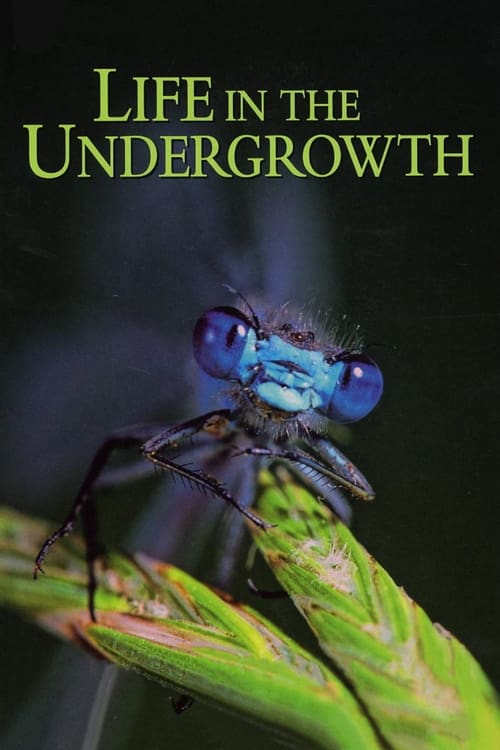
David Attenborough reveals the amazing stories behind the tiny lives of invertebrates, exploring their incredible miniature world with ground-breaking camerawork and technology.
▶ Watch Life in the Undergrowth
SOURCE ⚡ Select best server
Server 1 Server 2 Server 3 Server 4 Server 5 Server 6 Server 7 Server 8 Server 9 Server 10 Server 11 Server 12 Server 13 Server 14 Server 15 Server 16 Server 17 If one doesn't work, try another DOWNLOAD S1E1Multi quality · Multi audio Next Episode E2 — Taking to the Air →
Miniseries — 5 Episodes E1 · 49m
Invasion Of The Land
David Attenborough tells the story of the land-living invertebrates. He delves into the private life of Europe's dramatic leopard slug, a common garden resident with a truly bizarre end to its marathon mating ritual; watches the courtship ballet of tiny springtails on the underside of a leaf; sees swarms of bright red South African millipedes find partners, and in the caves of Venezuela meets the giant bat-eating centipede.
E2 · 49m
Taking to the Air
As the early June sun begins to set over a calm river in Central Hungary, masses of ghostly shapes emerge from their larval cases to take to the air for the first time. They are mayflies and in a spectacular display, thousands of them demonstrate how the very first wings were used. From the stunning aerobatics of hoverflies in an English garden to the mass migration of purple crow butterflies in the valleys of Taiwan, this episode tells the tale of the first animals ever to take to the air. Unique footage reveals the lightning fast reactions of bluebottles and hoverflies, filmed with one of the world's fastest cameras, and David Attenborough handles the world's largest (and perhaps most ferocious) insect - the Titan beetle.
E3 · 49m
The Silk Spinners
Silk is the invertebrates' great invention, used in a range of ways from from the protective stalks of lacewing eggs to the amazing hanging threads of New Zealand's 'glow worms'. Spiders, though, have taken silk-spinning to extremes. The common wolf spider has no web, but the female is a gentle parent, encasing her eggs in silk and carrying the precious bundle wherever she goes. The bolas spider uses a ball of sticky silk soaked in a copy of moth pheromone to lure its prey. Millions of communal spiders live and feed together in a vast, towering web - an arachnophobe's nightmare.
E4 · 50m
Intimate Relations
The world of invertebrates exists in a web of relationships with plants and other animals. Unique footage of the world's smallest insect (a fairy wasp only quarter of a millimetre long) shows it flying underwater to find the eggs of water beetles in which to lay its own brood. Some ants 'farm' the trees that give them shelter, creating areas known as 'Devil's gardens'. To make sure these grow without competition, they kill off other seedlings in the surrounding vegetation. The blister beetle's larvae huddle together on the end of a piece of grass and mimic a female bee. When a male bee tries to mate with the 'female', the larvae grab on to his belly. Confused, he flies away and searches for a real female. When he eventually finds her and mates with her, the beetle larvae hurriedly swap from his front on to her back, and hence get carried back to her nest where they eat her pollen supplies.
E5 · 50m
Supersocieties
Invertebrates don't always operate alone. True society was the last feature to evolve in invertebrates, as recently as the time of Tyrannosaurus. In the last programme see the tensions below the surface in some of the great social structures built by insects, and witness the carnage when an ant colony and a termite colony wage war.
Comments Latest Most Popular